

Chemical storage refers to the structured storage of hazardous substances in a controlled environment. Unlike simple organization, which manages the day-to-day arrangement of bottles, storage involves dedicated infrastructure, such as a chemical storage room and filtered storage cabinets, designed to isolate hazards.
CHEMICAL STORAGE
Chemical storage: ensuring the safety and compliance of your laboratory
Chemical storage is far more than simple logistical organization. It is a fundamental pillar of workplace safety that helps prevent the risks of fire, explosion, poisoning and environmental pollution. For professionals, mastering the storage of hazardous products is both a legal obligation and an operational priority.
What is chemical storage in a professional environment?
Improper storage exposes companies to major risks: devastating fires caused by poorly isolated flammable products, explosions due to vapor accumulation, and chronic poisoning linked to imperceptible leaks. Faced with these hazards, implementing a chemical storage plan becomes an absolute priority for every HSE manager.
Why use suitable storage equipment?
Protect users and facilities
A suitable chemical product storage system significantly reduces the risks associated with handling chemicals. It helps contain hazardous emissions, prevent accidental exposure and avoid critical situations such as fires or explosions.
In a laboratory, these systems act as a barrier between the potential hazard of the substances and the users.


How to store chemicals safely?
To limit risks, storage must strictly follow a rigorous chemical storage plan. This process begins with maintaining a permanent inventory to identify each substance, its specific hazards and its exact storage class.
Chemical compatibility
Stored chemicals must be separated by hazard class. It is essential to separate incompatible substances to prevent exothermic reactions or the formation of toxic gases. Flammable products, for example, require specific fire-resistant cabinets capable of delaying any rise in internal temperature in the event of an external fire.
Used chemical storage must not be overlooked. These substances may present increased instability risks if mixed and must be stored in sealed, clearly identified containers placed in dedicated retention areas until they are fully disposed of.
Erlab solutions for safe
and flexible storage.
Erlab offers a complete range of filtered storage cabinets designed to meet the strictest requirements of modern laboratories. Our solutions integrate advanced filtration systems that capture toxic molecules at the source without requiring costly connections to external exhaust systems.
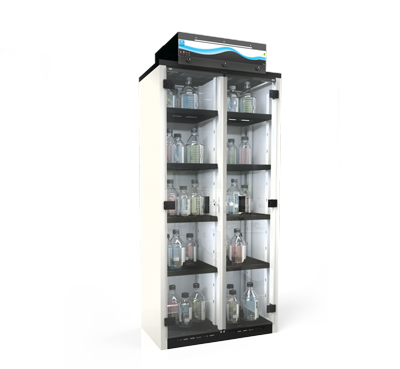
Filtration cabinet 832
Dimensions
W: 900 mm
D: 500 mm
H : 2050 mm
Storage capacity
120 x 1L bottles (glass) of compatible / incompatible products
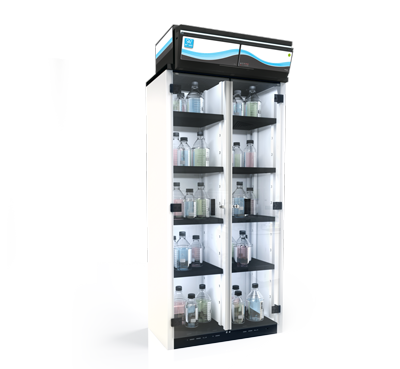
Filtration cabinet 834
Dimensions
W: 900 mm
D: 500 mm
H : 2140 – 2300 mm
Storage capacity
120 x 1L bottles (glass) of compatible / incompatible products
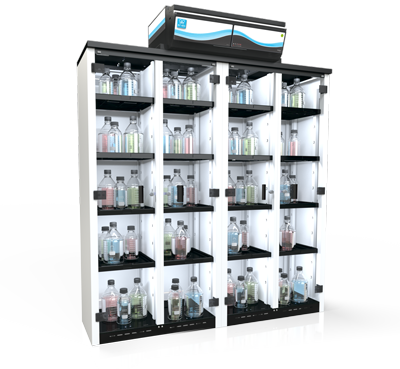
Filtration cabinet 1634
Dimensions
W: 1800 mm
D: 500 mm
H : 2140 – 2300 mm
Storage capacity
240 x 1L bottles (glass) of compatible / incompatible products
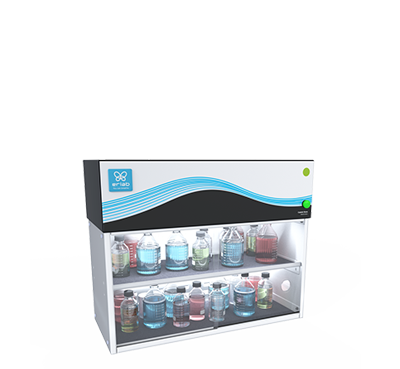
Filtration cabinet 531
Dimensions
W: 506 mm
D: 242 mm
H : 406 mm
Storage capacity
Approximately 72 x 20 ml bottles or approximately 10 x 500 ml bottles
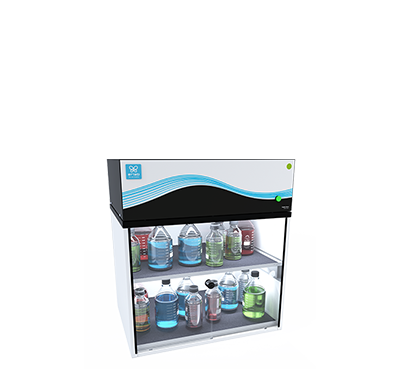
Filtration cabinet 632 A
Dimensions
W: 603 mm
D: 471,2 mm
H : 685 mm
Storage capacity
Approximately 24 x 1L bottles (high shelves) / Approximately 20 x 1L bottles (low shelves)
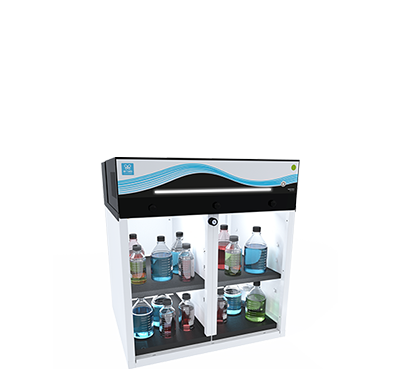
Filtration cabinet 632 B
Dimensions
W: 654 mm
D: 583,6 mm
H : 715 mm
Storage capacity
Approximately 25 x 1L bottles (tray) / Approximately 35 x 100 ml bottles (shelf) / Approximately 70 x 50 ml bottles (shelf)
Technical features designed for the user
Erlab cabinets stand out for their modularity and performance. Available in several sizes to suit all room configurations (on-bench or under-bench cabinets), they operate with a standard power supply and provide real-time monitoring of filter status. Investment in Erlab storage equipment quickly pays for itself through reduced energy costs linked to ventilation and long-term protection of surrounding equipment against corrosion.
Options and accessories for tailored protection
To optimize your installation, we offer a range of complementary options: additional retention shelves, secure locking systems for sensitive products, and saturation sensors for simplified preventive maintenance. These accessories allow each storage unit to be customized according to the specific requirements of your research protocols.
Regulatory framework and current safety standards
The legislation governing the storage of hazardous materials is strict and is largely based on the French Labour Code as well as the INRS recommendations. These regulations impose precise requirements on the nature of storage areas and on the use of certified safety cabinets.
Compliance relies in particular on the retention capacity of installations. In the event of a leak, the system must be able to contain the chemical product to prevent any pollution or chain reaction. In addition, storage rules require adequate ventilation to remove harmful vapors and maintain a healthy atmosphere outside the cabinets. Compliance with these standards provides both legal and human safety assurance for the facility.
FAQ
What is the difference between storing and organizing chemicals?
Organization refers to keeping products close at hand for immediate use, whereas storage concerns secure medium- or long-term conservation. Storage requires specific equipment, such as a chemical storage cabinet, to ensure ventilation and mandatory retention.
What are flammable products?
These are substances (solvents, gases, alcohols) capable of igniting rapidly when exposed to a heat source. Their management is critical and requires the use of a safety cabinet dedicated to flammable product storage to prevent any fire risk within the laboratory.
What are the rules for storing used products?
Used products must be stored in sealed, labeled containers placed on retention trays to prevent any pollution. It is essential never to mix incompatible waste in order to avoid dangerous chemical reactions or explosions.
What is the storage class of a chemical product?
The storage class is a classification based on hazards (toxic, corrosive, flammable) defined by the Safety Data Sheet (SDS). It makes it possible to physically separate incompatible product families to ensure personnel safety.
What is a chemical storage plan?
It is a technical document that maps the location, volumes and hazards of substances present within the company. This chemical storage plan is essential for emergency response planning and compliance with current safety standards.